
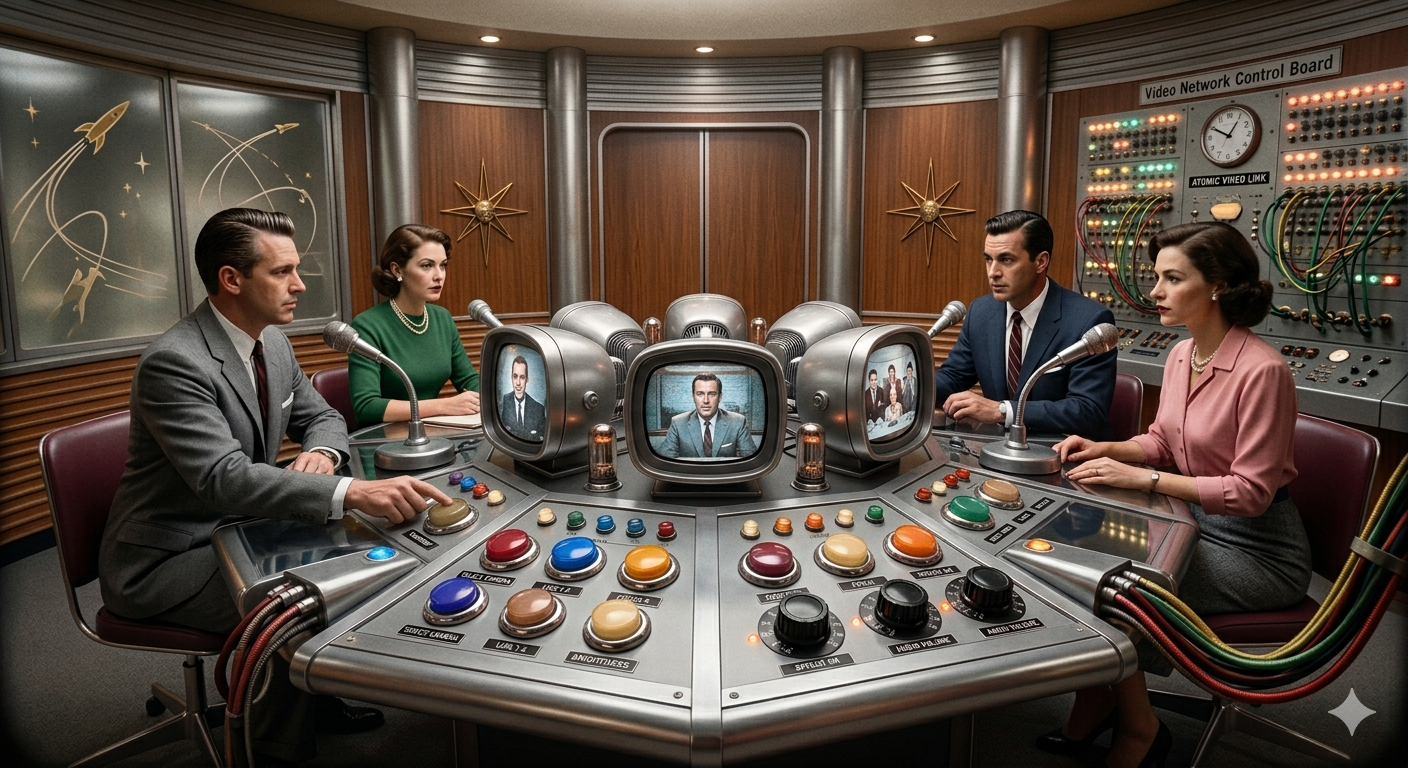
Videoconferencing developed in stages based upon aligning video and voice communication simultaneously over electrical lines of connectivity.
The birth of videoconferencing came about in the following four stages:
•FIRST STAGE: Invention of the telephone.
•SECOND STAGE: Invention of the television set.
•THIRD STAGE: Discovery of closed circuit video.
•FOURTH STAGE: Discovery of broadcast video.
FIRST STAGE: The invention of the telephone.
The phone was invented in 1876 by Alexander Graham Bell. He was the first individual to patent and promote the
telephone for modern commercial uses. The phone went through many modifications and improvements over the past 133 years and has become the central business tool that all businesses depend upon today for their communication needs.
SECOND STAGE: The invention of the television set.
The idea of transmitting an image over electrical wires dates back to 1884 by Paul Nipkow and then evolved to using a cathode ray tube in 1907 by Boris Rosing and Vladimir Zworykin. Later in the 1920’s, Vladimir Zworykin created the kinescope tube, which helped create the first modern picture tubes. All of this led to the transmission of pictures through electronic means. In 1927, Philo Farnsworth generated a television image comprised of 60 horizontal lines. This development was the dissector tube, which is the basis of all current electronic televisions. Beginning in the 1930’s, television was actively being broadcast by different countries and has been the main form of presenting information to the public for 79 years.
Source: http://inventors.about.com/od/tstartinventions/a/Television.htm
THIRD STAGE: The discovery of closed circuit video.
Between 1938 and 1940, Germany and Great Britain were the first to experiment with videoconferencing, developing a closed circuit video by broadcasting over a physical line going one direction and then another physical line broadcasting a simultaneous video. This led to early forms of closed circuit videoconferencing. Closed circuit is still used today by businesses and government agencies via cameras for security purposes and as a form of local building-to-building communication.
FOURTH STAGE: The discovery of broadcast video.
In the 1950’s and 1960’s, NASA would use a broadcast videoconference to communicate with individuals in space. This was accomplished by using two radio frequencies like the lines in a closed circuit system; however, they replaced the physical line with radio frequencies using a UHF or VHF going in each direction. Early new agencies would also utilize this technology by broadcasting a videoconferencing call to bring in late breaking stories. This early form of videoconferencing was too expensive for the average consumer and was only utilized at the government and TV station level.
DIGITAL TELEPHONY:
Used in the 1980s, Digital Telephony is the use of digital electronics in the provision of digital telephone services and systems. This replaced the older analog system and improved the compression rate over phone lines, which allowed for videoconferencing calls to be made over phone lines at a compressed rate.
IP BASED COMMUNICATION: BIRTH OF MODERN VIDEO CONFERENCING
In the 1990s, IP (Internet Protocol) based communication became possible, and more efficient compression technologies were developed, which allowed personal computers to send and receive videoconferencing communications
In 1993, after a competitive 1992 bidding process, the U.S. National Science Foundation created the InterNic to manage the allocations of addresses and management of the address databases. InterNic awarded the contract to three organizations: Registration Services would be provided by Network Solutions; Directory and Database Services would be provided by AT&T; and Information Services would be provided by General Atomics. (See http://www.ripe.net/ripe/maillists/archives/lir-wg/1992/msg00028.html. ) In 1994, InterNic started selling business URLs, which marked the beginning of the modern business Internet. This opened the door for an inexpensive connectivity for transferring data between businesses, which allowed for cost effective videoconferencing communication to emerge.
IP BASED VIDEOCONFERENCING:
In 1999, enlighten was one of the first companies to provide a turnkey videoconferencing solution. The enlighten network included data lines, bridging, content, routers, switches, and technical support. In 2000, enlighten was also one of the first companies to create a converged data network to support video calls on an IP based network and, in mid-2000, enlighten set up a one-call-resolution support center designed to answer videoconferencing questions and resolve network issues. In addition, enlighten provided two options for the equipment needed to communicate via two locations: As a reseller of videoconferencing equipment, enlighten offered off-the-shelf units. As a custom designer, enlighten offered its own equipment, tailored to meet the clients’ specific needs. Prior to this date, not a single organization provided all of these services under one roof; businesses were forced to shop one source for video equipment, a second source for network connectivity, and a third source for support and maintenance of equipment. enlighten cleared the path for individuals to easily enter the world of videoconferencing by offering itself as a single source provider of equipment, network connectivity, technical support, and maintenance – just as the cell phone companies had done for the wireless market.



0 Comments